
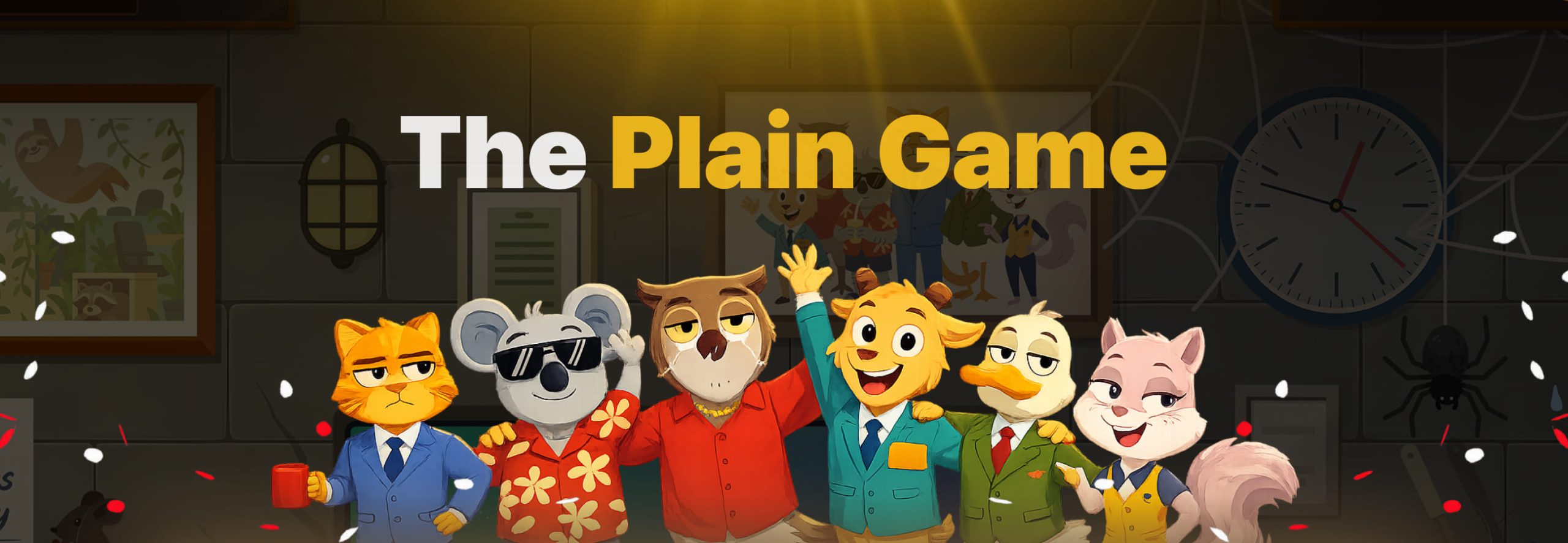


When it comes to workplace writing courses, the main problem is always the same – they are catastrophically dull. A slide deck and a quiz are not only boring workplace cliches, but also easily forgettable. So, the issue is not in the training itself. But how it is delivered.
Fgfactory did not go the same road for In-Game Learning. Our team built The Plain Game, a browser-based training product that teaches plain language writing through play. The course itself already existed; we built the game that delivers it. No lecturing is here, just active participation that allows us to learn quickly and efficiently.
Plain language is the skill of writing so that readers understand you the first time. The course behind the game has been taught for 30 years, in nine countries, to more than 25,000 people. Importantly, the material players work through is established training, so we did not invent anything to just put in a gamification e-learning platform.
The Plain Game is made for working professionals who want to write more clearly, and for companies that want the same from their teams. In this case study, we will explore how the game is built, and what tactics it uses to teach its subject. Moreover, we’ll tell how Fgfactory added game mechanics on top, making it one of the clear examples of educational game development applied to corporate training. Read on!
The concept of learning plain language through play
If you take any standard course, you will have a very typical structure: the learner reads the material and then answers questions about it. The Plain Game works differently, mimicking the real life situation. The player takes on a role in an office and does the work.
Of course, abstract questions about clarity can be also beneficial in a way, but in this case players are given situations that resemble real tasks. For example, a colleague asks for help, or a request comes in that needs a reply. Finally, the document has to be written for a particular reader with a particular need. The goal of a player in this eLearning gamification is to understand correctly what that reader actually needs, which is not something far from reality, as the same decision people make at work every day.
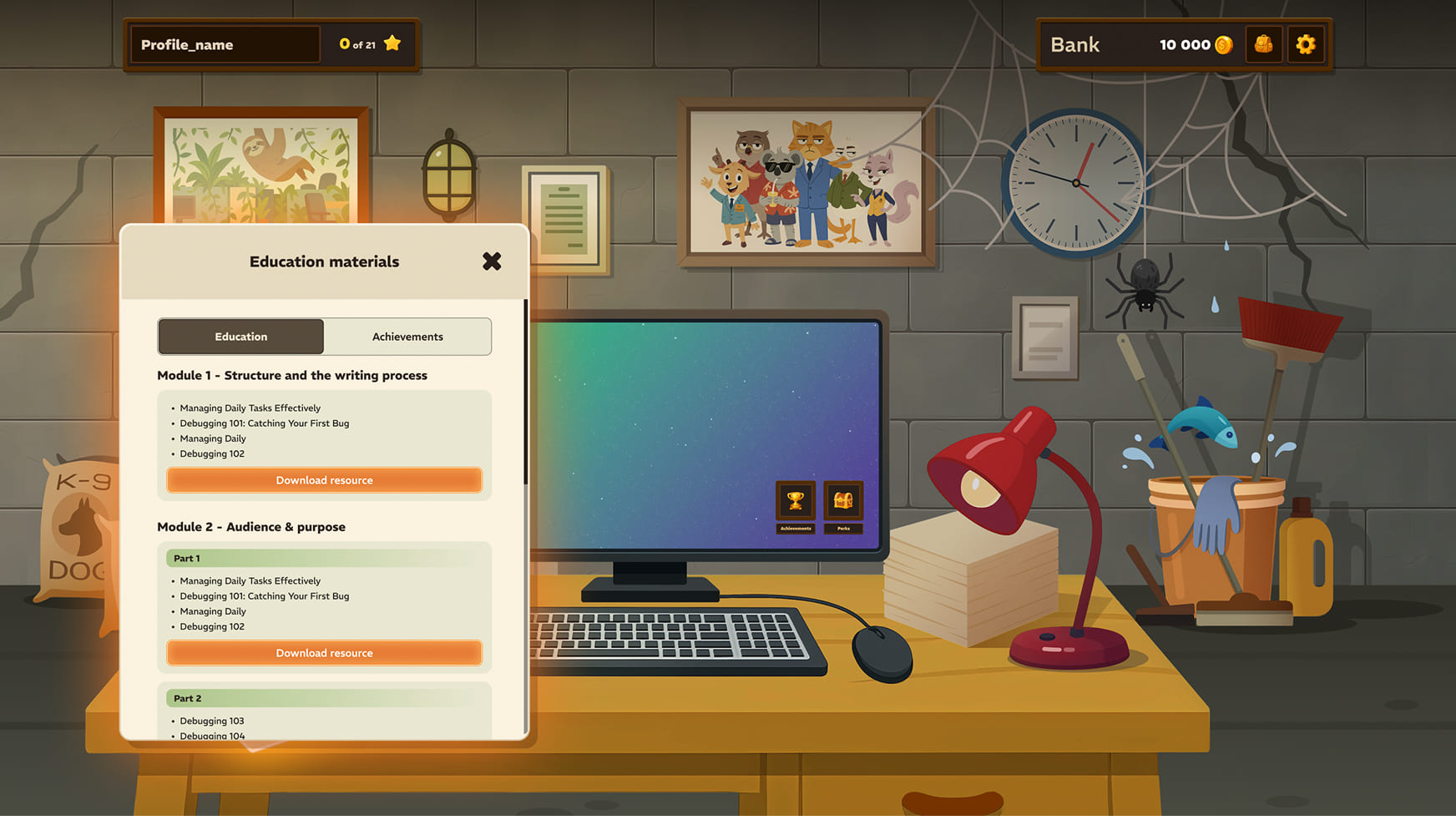
The office setting allows the player to have a desk, a computer, and a group of animal colleagues around them. The training takes place inside that office, not a plain quiz screen, so the situation resembles a workplace rather than a test. Fgfactory’s educational game development idea was to put the lessons inside a world the player was already familiar with.
Compared with manuals, slide decks, and static e-learning modules, a game asks more of the player (which helps to go through the learning process more efficiently), and holds their attention for longer. That is the reasoning behind gamified eLearning, and it is why In-Game Learning wanted a game. The wider benefits of gamification in eLearning hold true well beyond a single writing course.
The core loop and how the game teaches through feedback
We have created each topic in the way it follows the same steps. The player selects a topic, then comes a short introduction video a player can watch or to read the written material. Only then starts the quiz.
The quiz is not one long test, and it is not the same task every time. The questions come in several formats, so the player meets different kinds of challenges as they move through a topic. That variety keeps things fresh and does not make players feel like they are playing with the same mechanic on repeat.
The material can be downloaded and kept as education resources for later reference.
Feedback is the most meaningful teachable experience and one of the education resources. When the player answers correctly, the game explains why that answer is right and links it back to the plain language principle behind it. But when the player provides an incorrect answer, the game explains why the choice was wrong, so a wrong answer becomes part of the lesson.
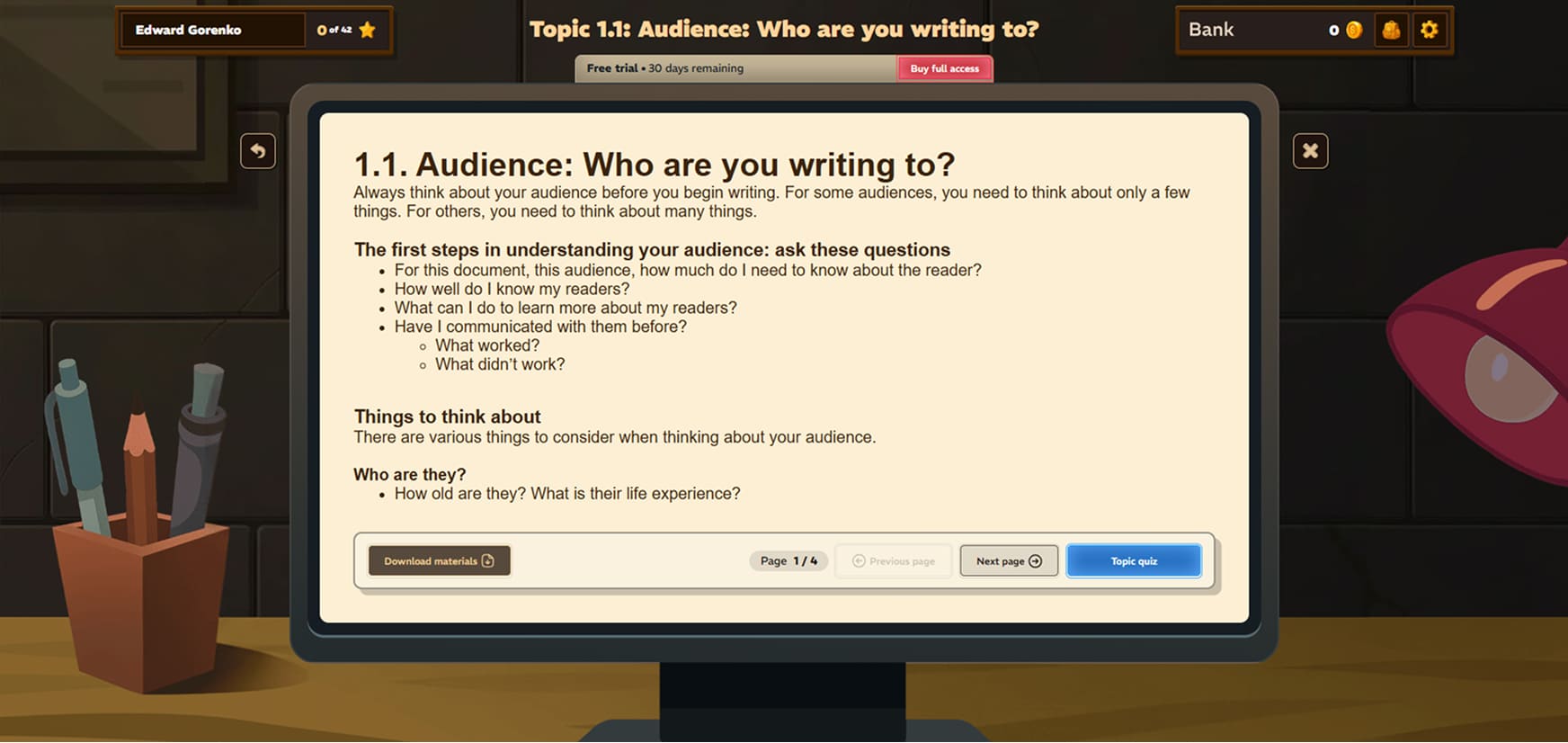
In other words, the player learns from the reasoning, without chasing meaningless scores. Seeing why an answer works, at the moment of answering, is what makes the materials behind the lessons remain in long-term memory. This is a common principle in eLearning gamification: the game mechanic and the lesson are the same thing.
A round can be replayed if the player wants to improve. The game rewards getting the answer over time, which is actually how people learn a skill in practice.
Pro Tip:
In gamified e-Learning, put the explanation in the feedback, and avoid placing it in the score. People remember why an answer was wrong far longer, and they won’t have any educational effect from seeing a percentage, as its role is different.
What players learn across the four modules
The Plain Game is organised into four modules, and each one designed to cover a real part of writing.
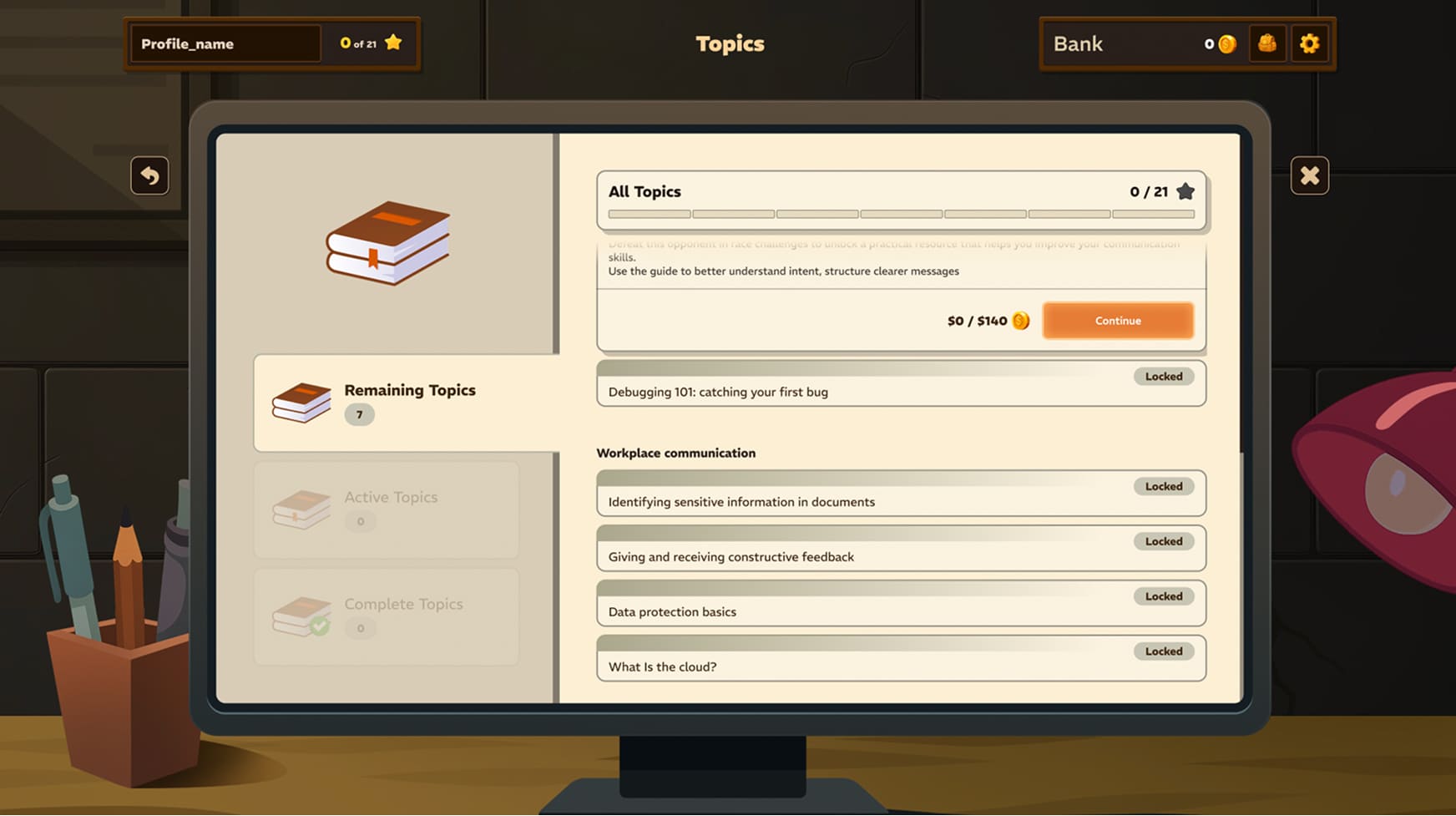
- In Module 1, which is called Audience and Purpose, players learn about whom the writing is for and why it exists.
- Module 2, The Writing Process, shows how to plan and draft a piece, so it holds together.
- Module 3, Write for your Readers, covers word choice, structure, and clarity from the reader’s point of view.
- Module 4, Writing that Connects with your Readers, is dedicated to tone and the details that make writing easier to read.
The content follows established writing standards and there are no, as one might think, some company’s preferences, which gives it credibility. There are real instructions that are following the depth of the topic to a certain extent allowed by educational game development, and every topic comes with downloadable education resources the player can keep. Keeping that depth intact is one of the harder parts of eLearning platform development, because the game elements have to support the lessons without getting in their way.
A real gamification economy that rewards progress
On top of the course, Fgfactory built a progression system with two currencies: stars and coins. It is an important part of eLearning gamification, and it enhances the learning results, making the game more enjoyable.
Stars are created to measure how many tasks were completed by the player. The game tracks the player’s stars against a total of 42, and it states that a player needs at least 65% of the stars to finish. This gives the player a visible target that is above the individual modules.
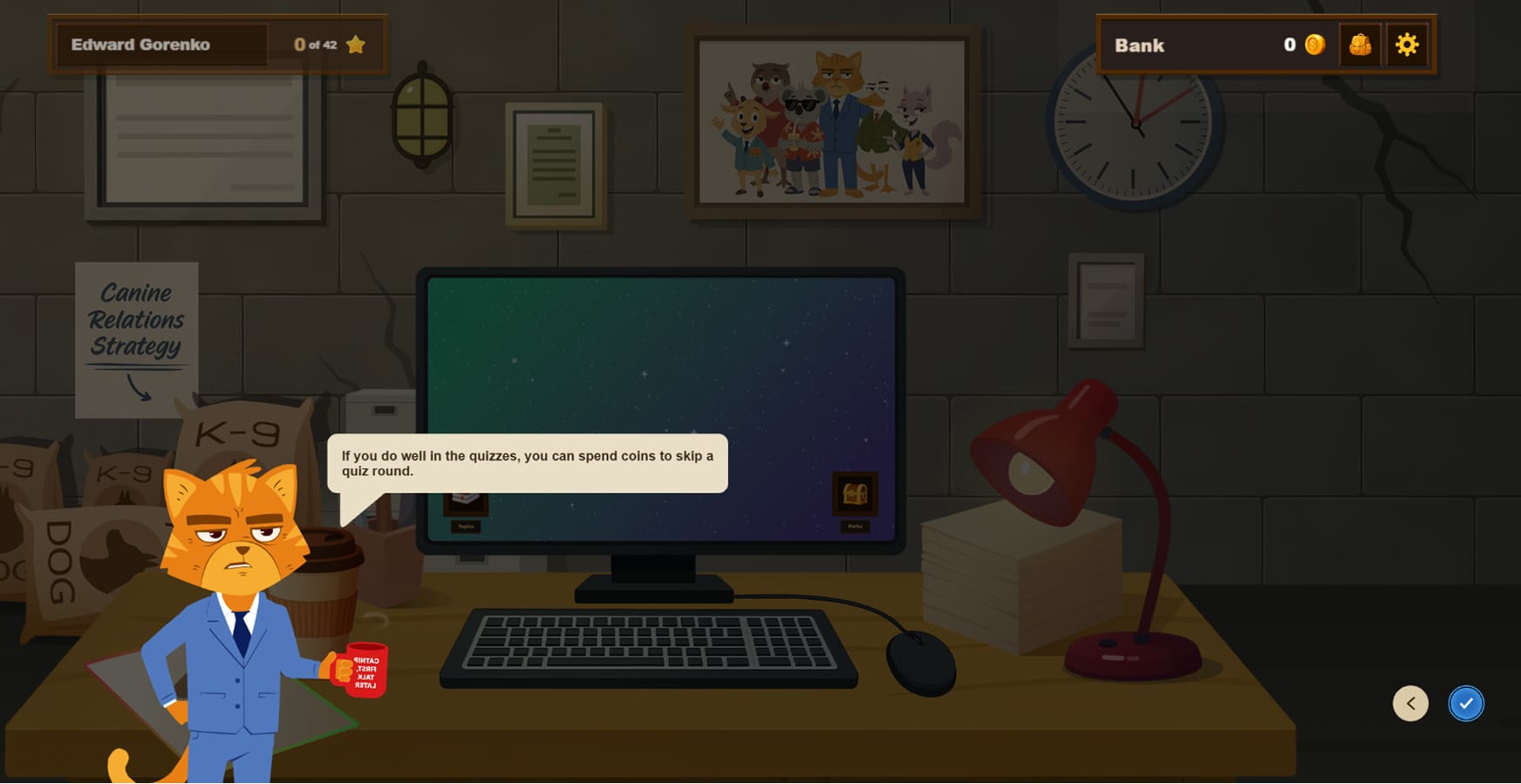
Coins are earned through quiz performance and spent in other parts of the game. The two currencies do different jobs: stars show how far the player has progressed, and coins reward the work that got them there.
Now, why do we decide to add all that? A simple quiz app is easy to build, and its value for learning is decent. However, a reward system added to real training content takes much more effort, and it is what creates the difference between a course with a theme and genuine gamification in e-Learning. Fgfactory was aiming for this second type, which is a more demanding piece of educational game development. The same reward logic sits behind the strongest budgeting games for adults, where players practise a real skill instead of reading about it.
This is also the stage where eLearning gamification becomes a system with its own rules and balance.
Did You Know?
Setting the completion goal below 100%, here at 65% of 42 stars, tends to keep learners moving. Why? Because the target is definitely reachable, and people feel that which prevents them from stopping at the first difficult topic.
The game loop as a system of rewards and personalisation
Beyond the topics and quizzes, Fgfactory built a second layer of features whose purpose is to bring players back: a home base, a competitive way to play, and rewards that let players change their space. This second layer is a large part of what makes gamified e-Learning worth returning to. The features work together as one system, and the sections below move from how the training works to how the game keeps people engaged.
The office, your desktop, and your progress
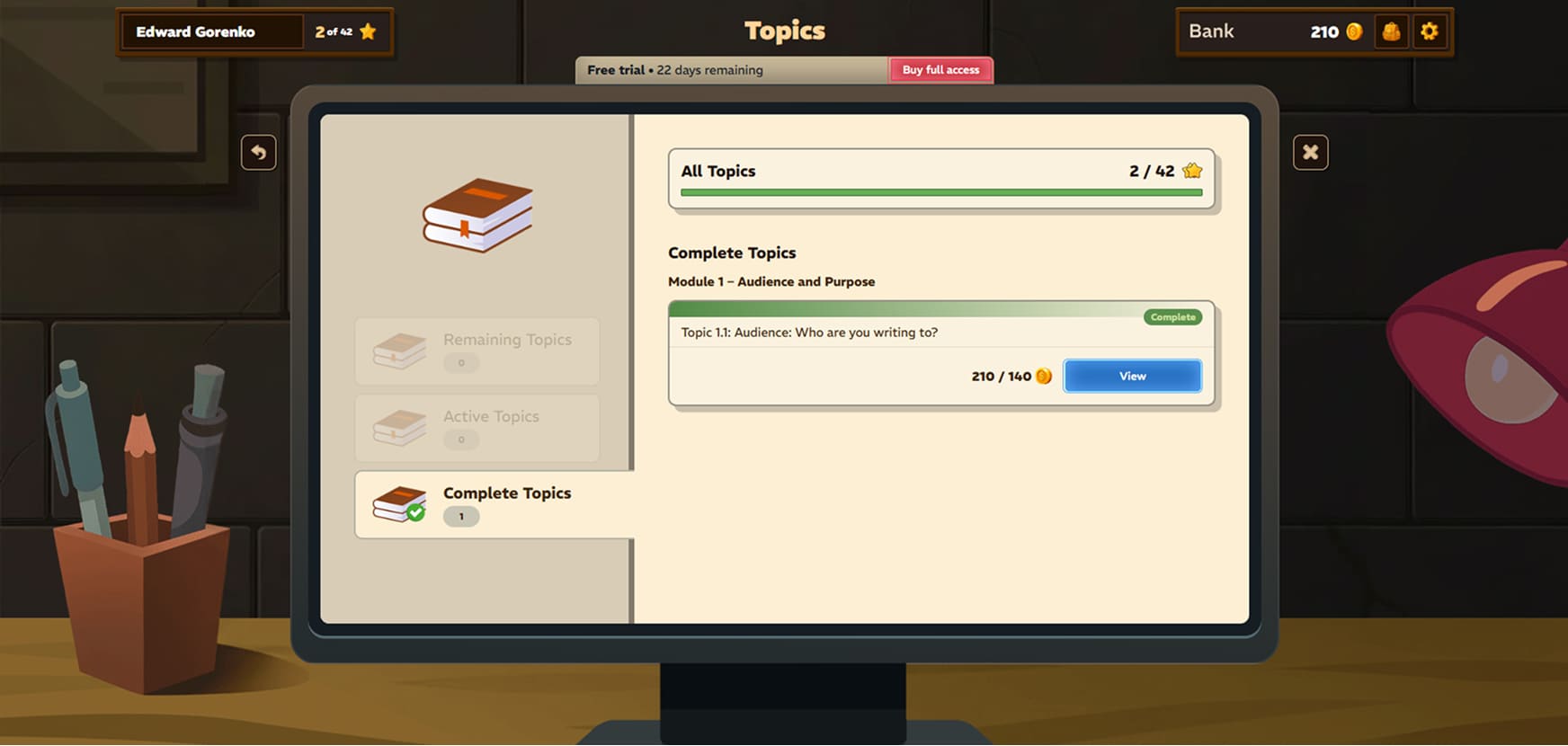
The office is the player’s home base. It is the desk they return to between topics, and it always shows two things: their star progress and their Bank, which is the running coin balance. The player can see the progress and where they are all the time.
From the office, the player opens “My desktop,” the main screen inside the game. It holds three icons: Topics, Achievements, and Perks, and it helps to see and move through the game from one place. A permanent hub like this is one way gamification in eLearning should be built into the structure of a product. It won’t be the same if you just add it on top.
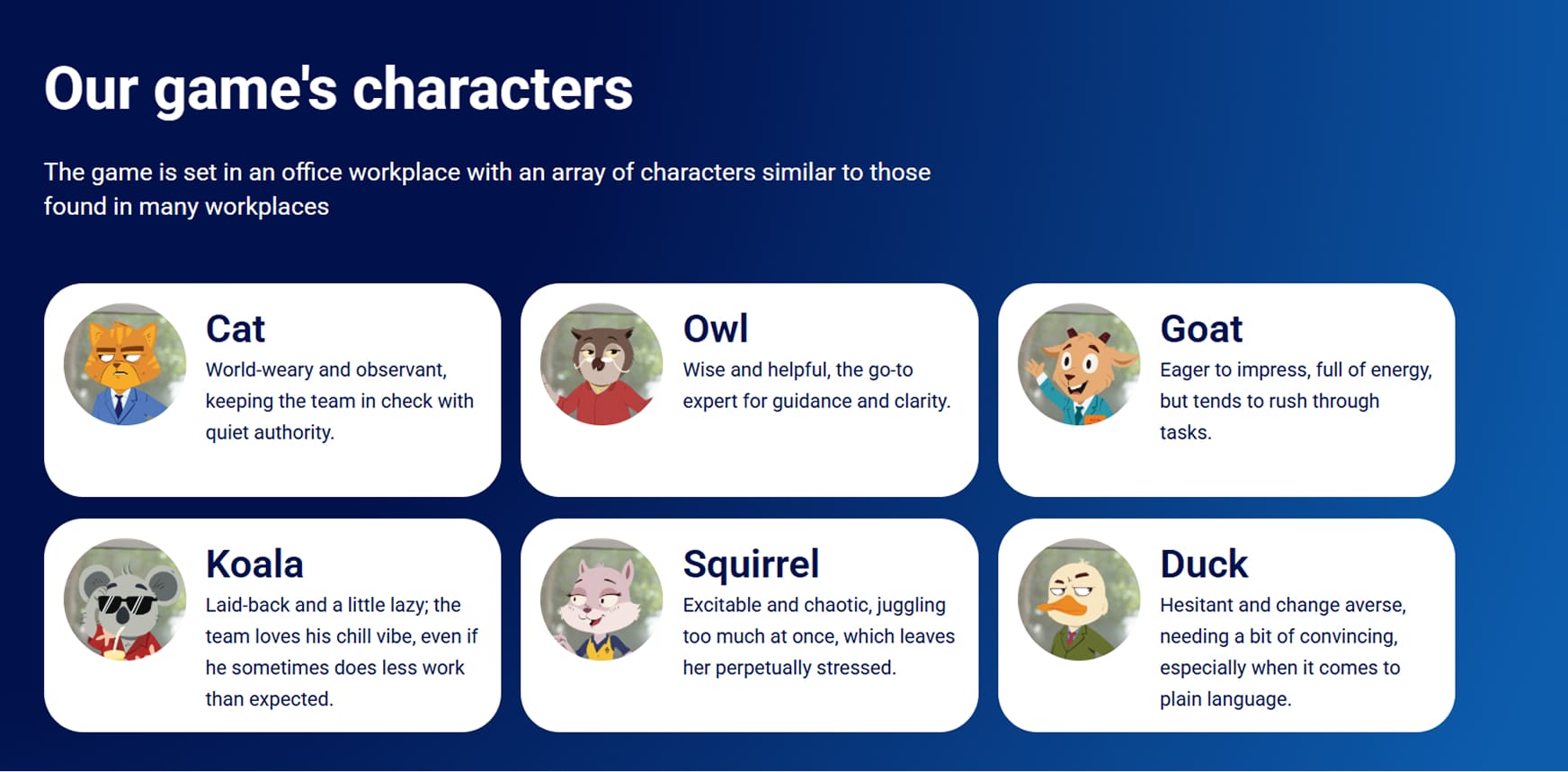
A group of animal characters guides the player through speech bubbles at the right moments:
- Cat is world-weary and keeps the team in order
- Owl is the reliable expert
- Goat is eager and tends to rush
- Koala is relaxed and does the minimum
- Squirrel takes on too much and stays stressed
- Duck is cautious and slow to accept change.
Together they give the onboarding some personality, and you can compare how different it is to a series of plain instructions in terms of engagement. When you are engaged in e-Learning platform development, making sure that surrounding game elements work is highly important.
Quizzes, Normal mode, and Race mode
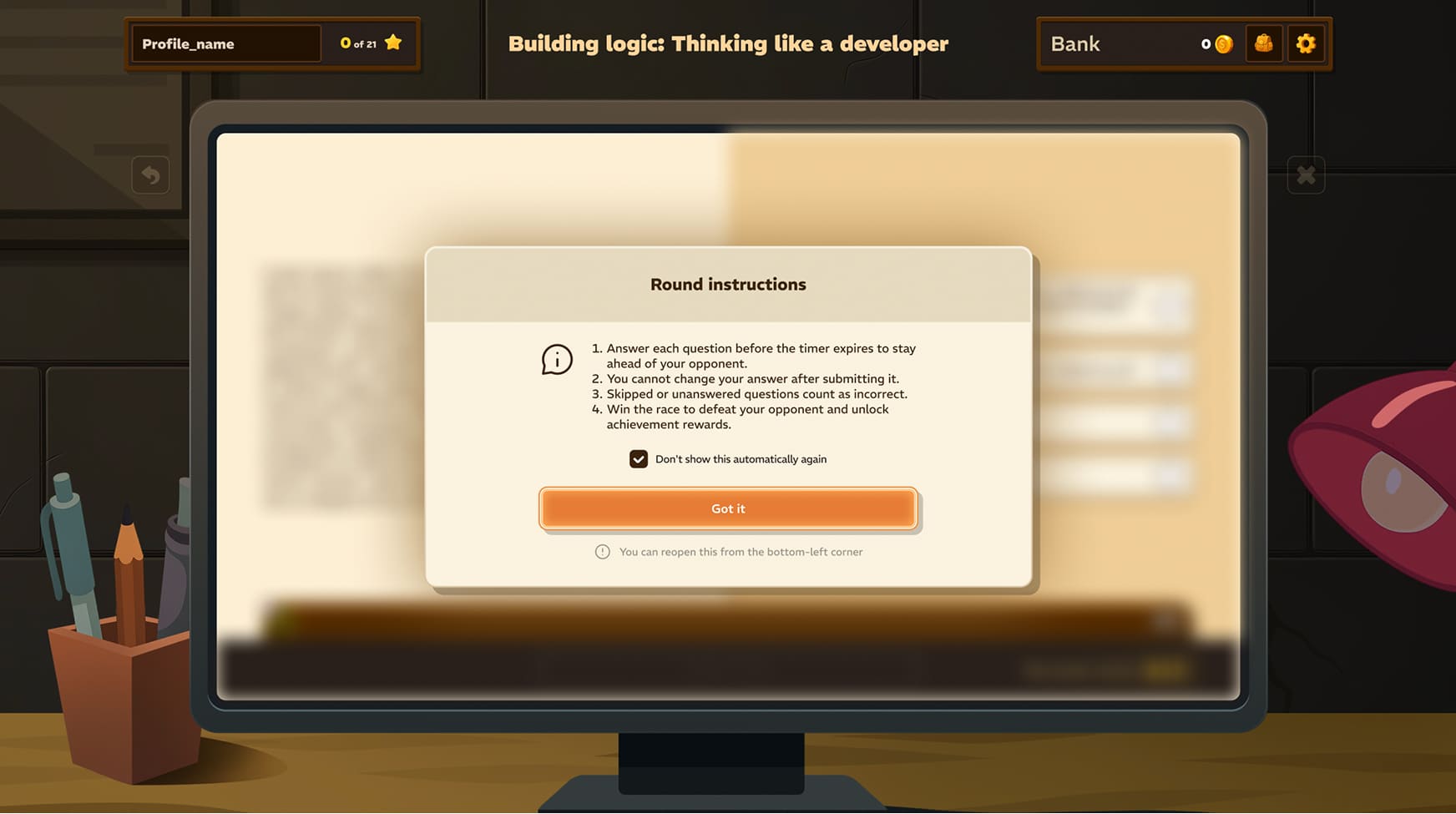
Each topic quiz runs across four rounds of four questions. That structure never changes, the only difference is how the player chooses to take it.
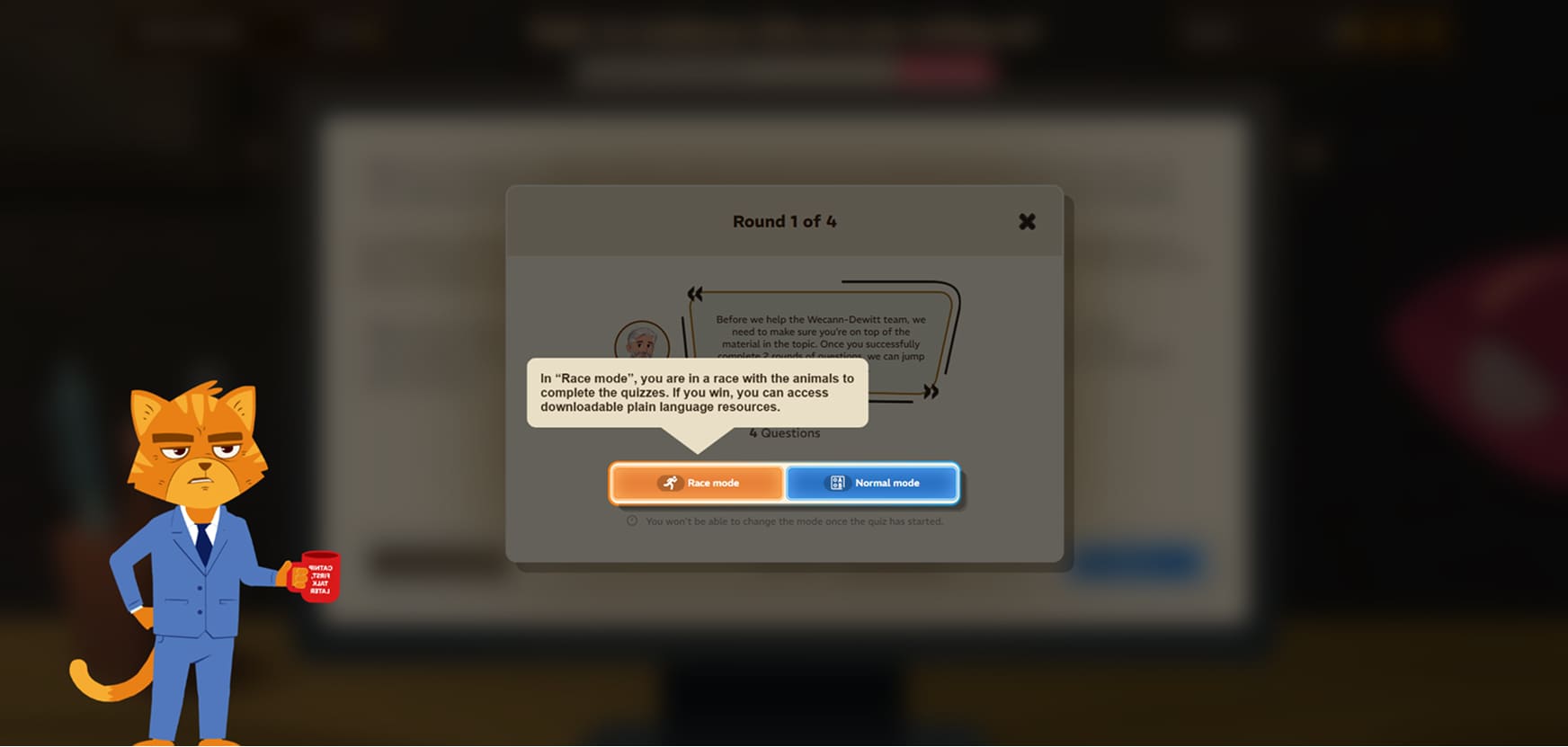
Normal mode is the standard version. In Race mode, the player competes against the animated animal characters to finish the quiz first, and winning unlocks downloadable plain language education resources as a reward. Once the player selects Race mode, they cannot switch back partway through, which adds a small stake to the choice.
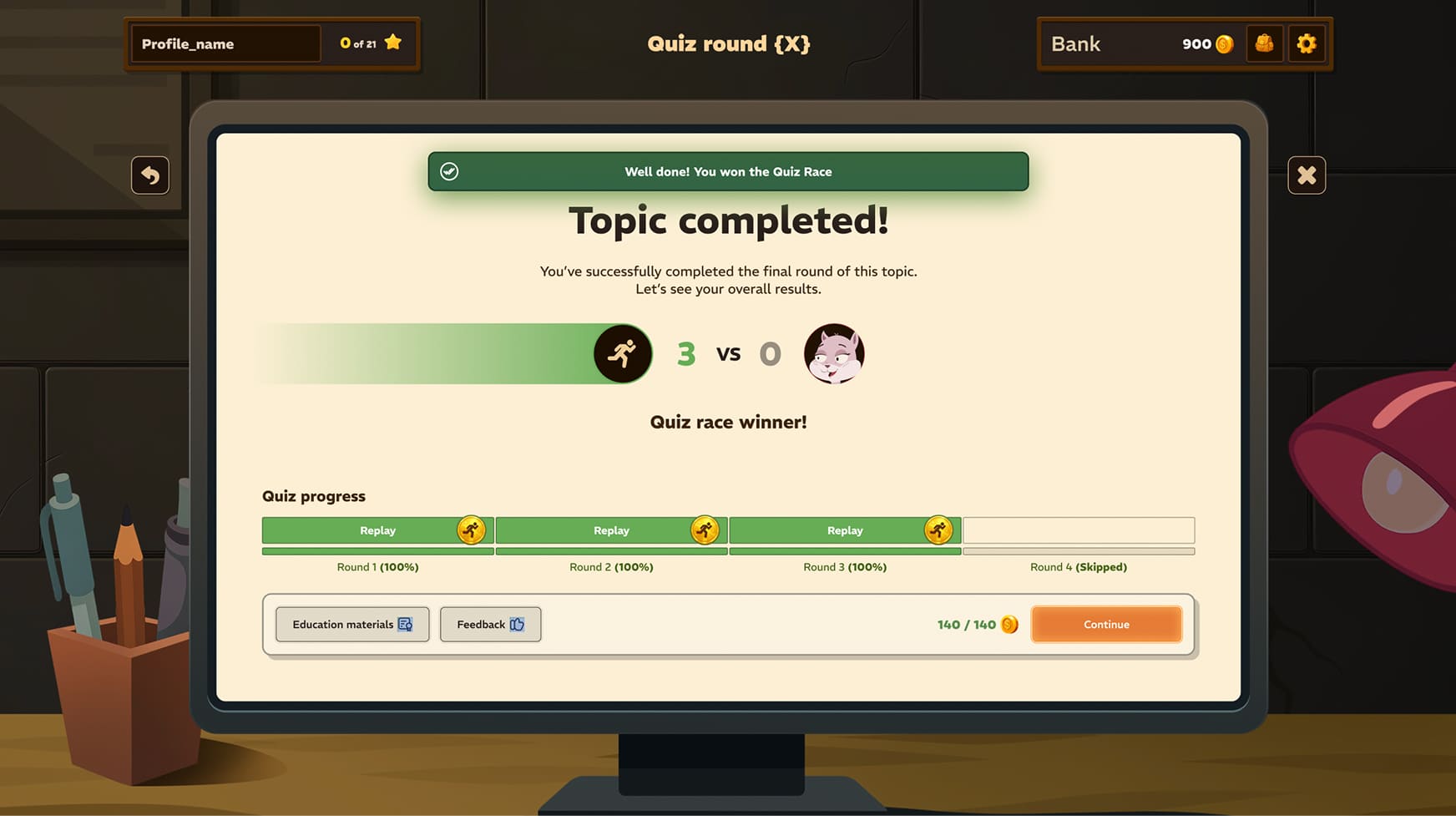
Race mode is the most openly game-like part of the product and the least like traditional training. It shows Fgfactory building genuine competition on top of assessment content, helping to improve the quality of gamification in eLearning in this particular case.
Perks, inventory, and achievements
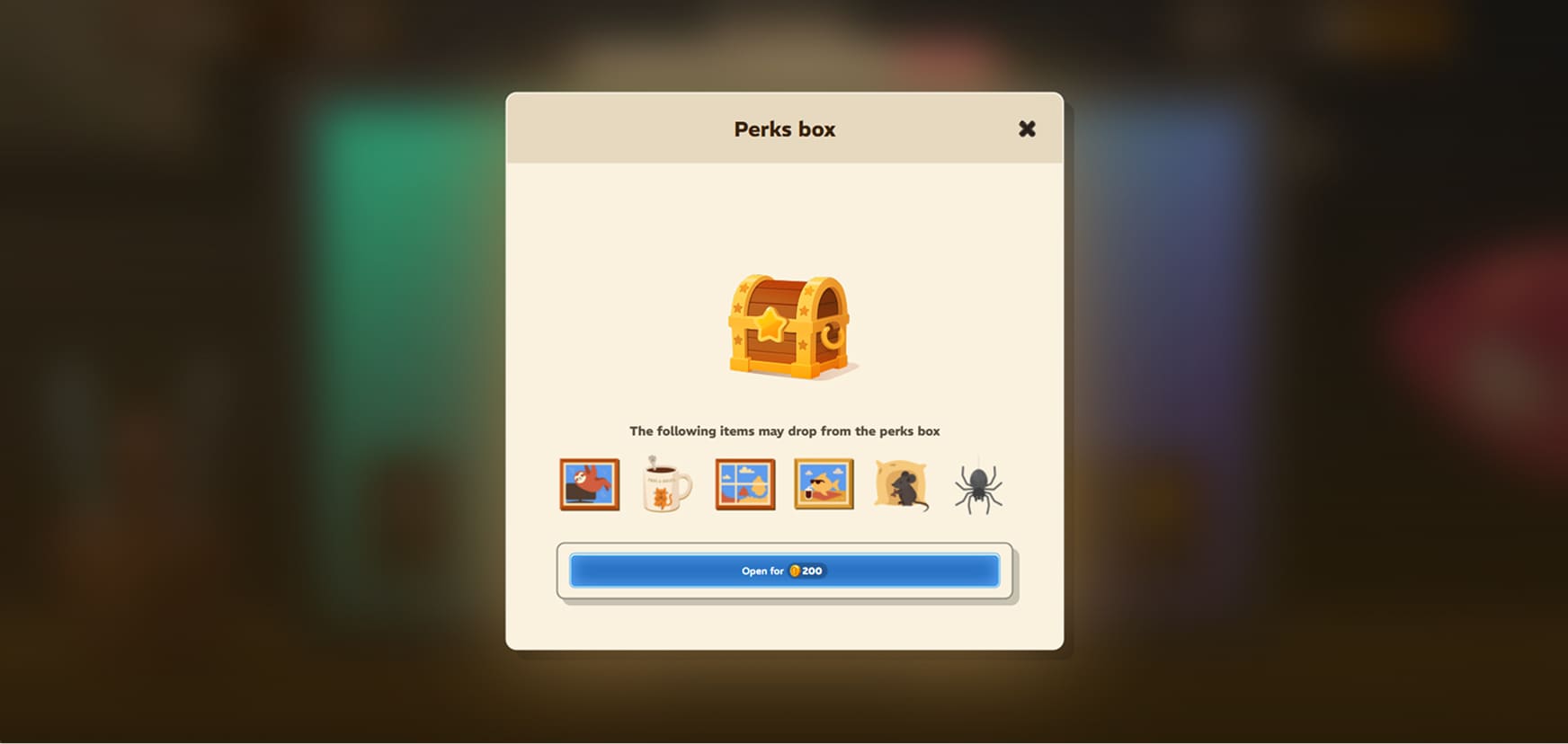
The Perks box is easy to recognise for anyone who has played games before: it is essentially just a lootbox. The player spends coins to open it and receives a cosmetic office decoration which could be anything interior-like (a picture frame, a mug, a plush toy) or more habitual like a spider. These rewards are less about learning; they are purely cosmetic. Their purpose is to give the player something to collect.
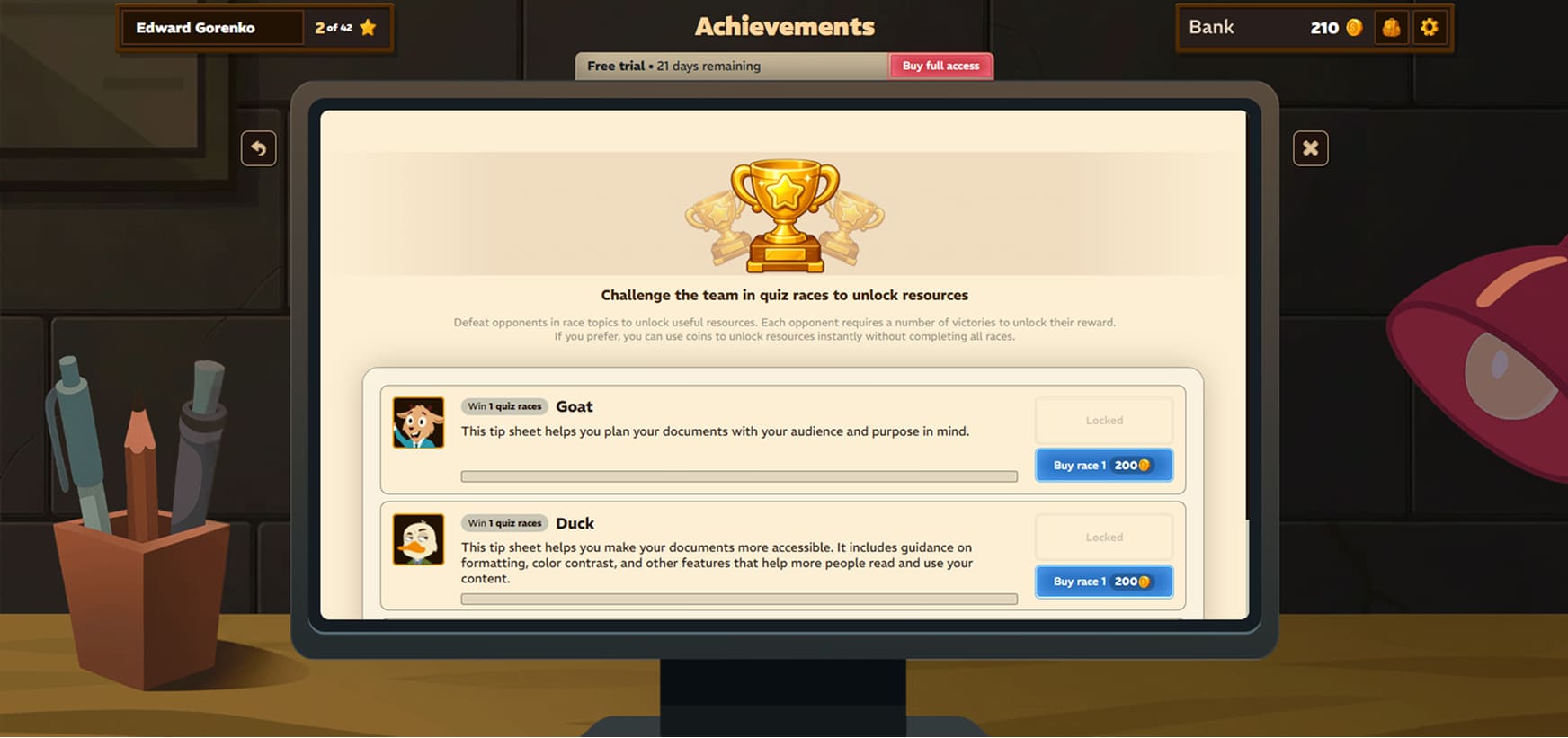
Collected decorations go into the player’s inventory and stay there until the player places them. Slots on the Table, the Wall, and the Floor let the player arrange decorations and personalise their office, as simple as that, but a very important part of the gaming experience. This is a part of gamification in learning and development that just enhances the education effect.
Pro Tip:
Cosmetic rewards are easy to underrate. Letting learners personalise a space of their own changes from “I finished the training” into “I want to go back to it.”
A certificate at the finish line
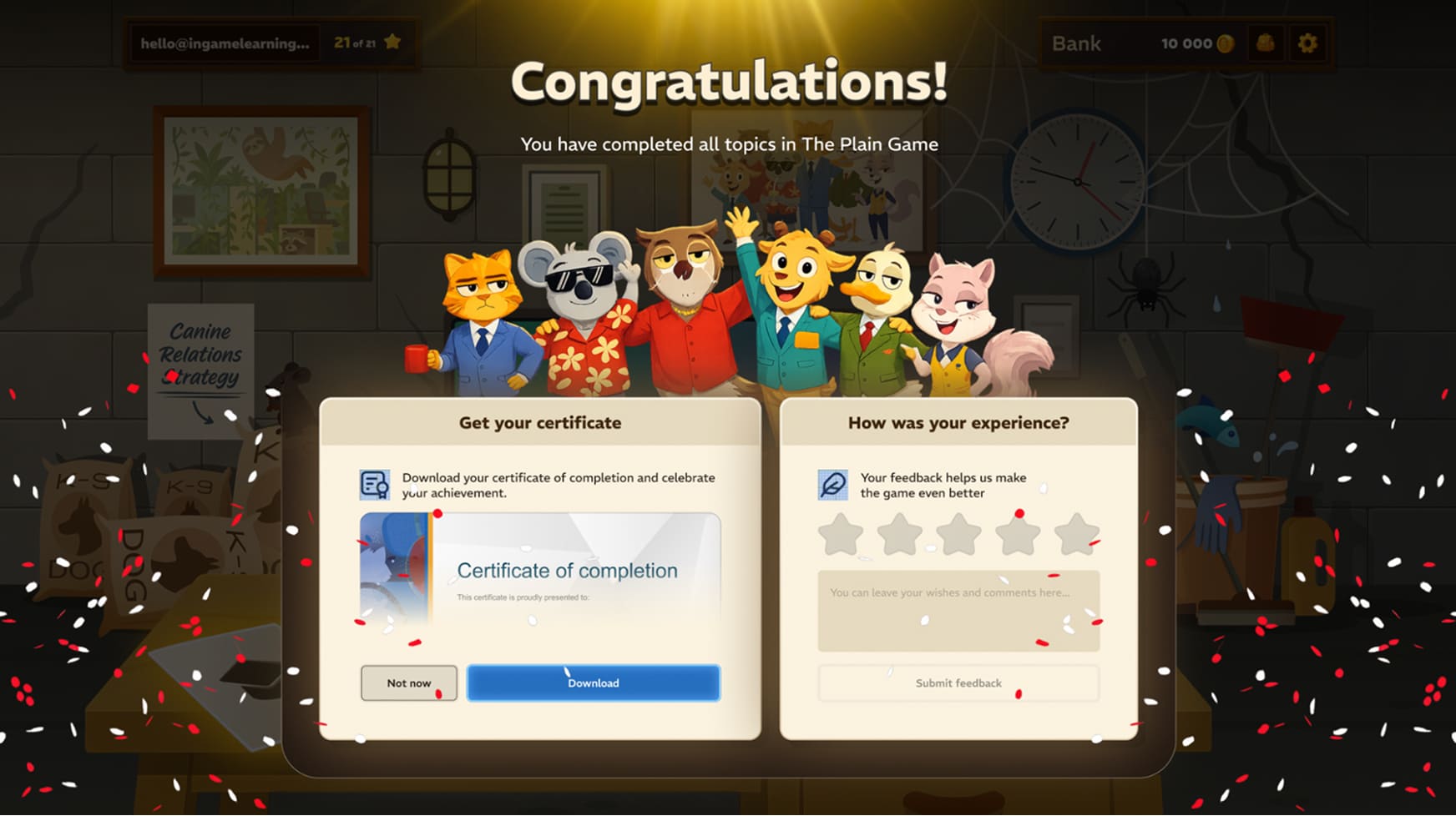
Finishing the course is its own reward, and there is a formal one too. When a player completes all four modules, they earn a certificate that marks the achievement. It confirms they have worked through the full plain language course, and did not stop at just one topic or on the halfway.
For an individual, the certificate is proof of a new, practical skill. For a company, it is a simple way to track who on the team has completed the training and to show that the work was done.
Built for the browser, one licence, twelve months of access
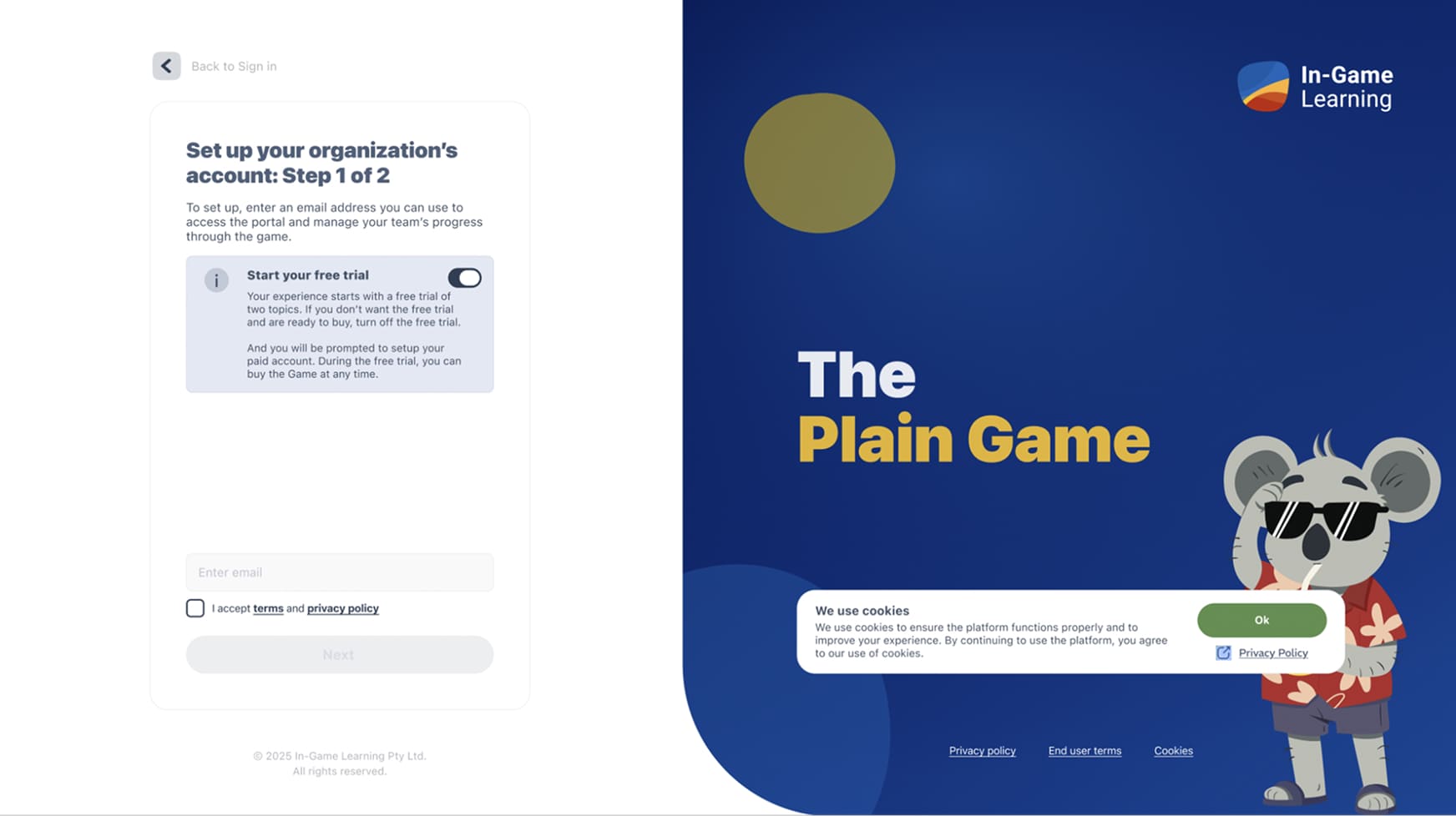
This game is in many ways about accessibility, and an easy way to learn writing efficiently. That’s why it is also really easy to start playing: all you need is just a browser. There is nothing to download or install, and no complex or even slightly demanding IT setup is required. The player opens a link and starts.
There are two ways to buy it.
- Individual licence: $199 AUD, paid once. It includes 12 months of access to The Plain Game and any updates released during that period. It also includes future access to two upcoming tools, the Plain Language Skills Trainer and the Skills Gap Assessment, once they are released.
- Organisation licence: $199 AUD per user, paid once, scaled to the number of licences an organisation needs. It includes everything in the individual licence and adds an Admin Analytics Dashboard for tracking a team’s progress and measuring the effect of the training.
The dashboard is a large part of the system in its own right. From it, an admin manages the organisation’s licences, adds and removes users, and controls which topics each person or group works through. It is the control centre for rolling the training out across a team.
Progress tracking sits inside that dashboard too. An admin can see how far users have come and measure the effect of the training. That reporting is useful, but it is one feature among several, not the whole of what admin access offers.
A free trial is available with no credit card required, so buyers can try the game before paying. Running the product in the browser is a deliberate choice in the e-Learning platform development process, because fewer steps between a learner and the first quiz make the training more likely to happen. Fgfactory takes the same browser-first approach when building interactive marketing games for brands.
Did You Know?
Since The Plain Game runs in the browser, getting a team started is simple. The org admin sends out invites, and each member gets their own link to open and play. There is no software rollout. That removes one of the common reasons for gamification in e-learning stalls and makes teams stop at the very beginning.
Under the hood: the tech stack
The Plain Game is a real software product, not a slide deck with a score attached, so the engineering is very important here. The front end is built in Angular and PixiJS, which gives the game a responsive, app-like feel in the browser. The back end runs on Node.js.
Rather than one large block of code, the platform is made up of several components, each handling its own job, which makes the product easier to scale and maintain over time. It also helps with updates.
The infrastructure runs on AWS, using the set of AWS microservices for data storage, server load, and other important functions. There are also several integrations wired in to support the game, the admin tools, and the analytics.
This is the kind of setup that keeps a gamified learning platform stable as more users and organisations come on board. It is also where Fgfactory’s core strength shows: we are a technical team first, and the game sits on solid engineering.
Fgfactory’s expertise in gamification integration
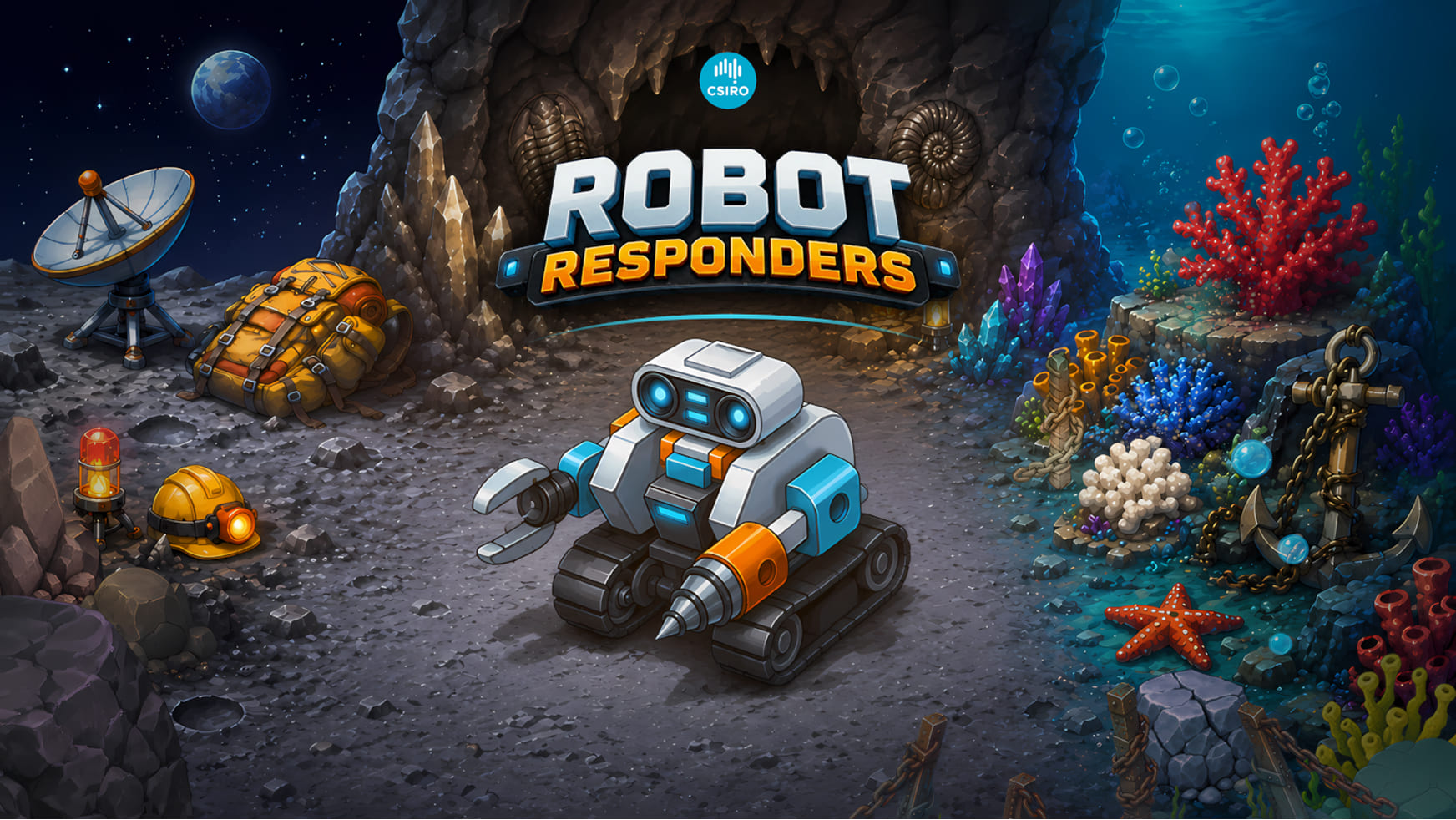
The Plain Game is positioned right next to the Fgfactory STEM game for CSIRO. In that project the team has created a science game for children, and in this case study we told you about professional training for adults. The two audiences are very different, and both were built with proper game design completely meeting very different needs, and specific nuances that each audience has. Fgfactory can do it thanks to years of educational game development across different types of briefs.
The main skill at work here is gamification integration. We were taking training content that already works just creating out if something people choose to play. This is different from building a game from the ground up, and it is what careful eLearning platform development looks like when the aim is engagement, not just delivery.
Strong gamification eLearning platform depends on that discipline, and the same approach runs through Fgfactory’s other gamified eLearning projects, we are always trying to design the reward systems as carefully as the lessons.
For an organization that already has proven training material, the question is not whether it can become a game. It is whether the development partner can build the progression, the rewards, and the overall feel that keep people coming back. That is the work behind every gamification eLearning platform Fgfactory delivers, and it is why the studio treats gamification in learning and development as an engineering task. Taking existing content and creating engaging educational game development out of it, supported by full-cycle game development, is the kind of project Fgfactory is set up for.
If you want to turn your organisation’s training into something your team will actually use, contact Fgfactory today.



Contact us